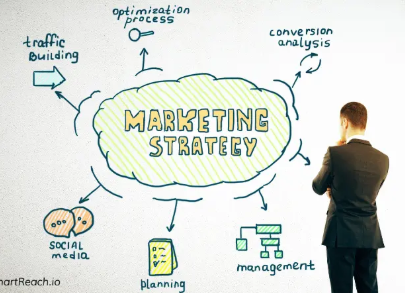
If you want to achieve results with your marketing, you need a consistent strategy. Marketing strategies define how we achieve the company’s objectives and help us coordinate the various aspects of a campaign, from creative to financial. So strategy is like a map that helps everyone in the company row in the same direction. We’ll tell you what elements make up a marketing strategy, which ones are most effective, and how to put them into practice.
What is a marketing strategy? A marketing strategy is the process that allows a company to focus on available resources and make the best use of them to increase sales and gain a competitive advantage.
Marketing strategies are aligned with the company’s business objectives. In order to apply these objectives to the development of a plan, we must specify and define them using the famous acronym “SMART”:
Specific: A goal must refer to a concrete and tangible achievement, e.g., “30% increase in lead generation from digital channels next year.”

Measurable: We need to be clear about which measurement tools are used to determine whether or not the goal has been achieved.
Achievable: It is important that the objectives present a realistic challenge, otherwise we can only upset predictions and demotivate the team. Relevant: Objectives must relate to the overall objectives of the company and have a clear connection. For example, if we want to have an impact on sales, the metric to follow should be the number of conversions and not interactions on Facebook.
Time-bound (with a deadline): The time frame for the marketing strategy must be clearly defined from the outset.
Another fundamental aspect of marketing strategy is what is known as the marketing mix or the “4 Ps of marketing,” which define four key aspects for business plans:
The product or service: what our company offers to customers. This includes the company’s portfolio of products and services, their life cycle, how they differ from the competition, branding, and packaging, among other things. It should be noted that the definition of the product must be based on the needs and motivations of the customer and not on technical aspects.
Price: The price of products is one of the most complex marketing decisions, as several factors come into play, such as manufacturing costs, profit margin, demand, positioning against the competition, the purchasing power of our potential audience, and many others. This section also covers aspects such as payment methods and discounts.
Promotion: all communication activities carried out by the company to publicize its products and services in order to increase sales. It encompasses various branches of communication such as advertising, public relations, door-to-door sales, and digital marketing. Point of sale or distribution: the various channels through which products and services reach consumers, from online stores to chain stores. In addition to the customer experience, this point also includes aspects such as access, storage, transport management, and stock.
Types of Highly Effective Marketing Strategies
Inbound Marketing
This involves seeking out customers who come to the brand rather than seeking them out.
To this end, the brand offers a series of resources to help users solve problems related to its products and services, such as tutorials or downloadable guides. These resources act as an incentive for users to join the database and build a relationship with the brand that culminates in conversion. 2) Content Marketing
The content marketing strategy is based on creating value for users through content in different formats: blog articles, infographics, videos, etc. This content serves as a starting point for promoting the brand and capturing leads.
Email Marketing
Email marketing is one of the longest-standing marketing strategies and one of the most effective year after year. The purpose of email is to establish a direct channel of communication with users, through which we nurture our relationship with them. We can therefore use it at different stages of the customer journey, from initial contact to final conversion.
Social Media Marketing
Social media marketing is based on reaching users through the channels where they spend most of their time. It uses the phenomenon of “social proof” to encourage virality and further boost the brand’s content and proposals.
A key element of your social media marketing strategy is choosing the right channels, from LinkedIn for B2B companies to TikTok for brands interested in reaching Generation Z.
Social Ads
Social media ads use this showcase to generate targeted traffic and conversions. One of the biggest advantages is segmentation, as they use information gathered from social media to precisely target ads to the brand’s target audience.
Retargeting
For most brands, conversions do not come from the first impression, but require multiple touchpoints throughout the customer journey. Retargeting is a marketing strategy that allows us to contact users who have already interacted with the brand to further foster the relationship.
Account-Based Marketing
This marketing strategy is particularly suitable for B2B brands and aims to achieve the highest level of segmentation. Instead of targeting a group of users with common traits, account-based marketing focuses directly on specific business decision-makers. This allows for a significantly higher degree of personalization and thus multiplies conversions.
SEO
SEO is a marketing strategy that focuses on improving the organic positioning of a company’s website in search engines. The objectives are usually defined in the medium and long term. The result is that we obtain a source of visibility and persistent traffic at a low cost.
SEM
This is a complementary strategy to SEO based on placing paid ads on search engines. This allows you to get much faster results and drive campaigns directly to conversion.
Storytelling
It uses a format we are familiar with and love—stories—to engage consumers emotionally.
Rather than simply explaining a product’s features, storytelling allows us to tell a memorable story about who we are, what we do, and the problems we solve. This story can be presented in multiple formats, such as text, video, or interactive content.2 Examples of marketing strategies
Finally, we would like to share with you two examples of marketing strategies in which we have combined different resources to achieve business objectives.
Success story: Lipograsil
The company’s goal was to increase brand awareness, drive traffic to a website, and learn more about the consumption habits of its potential customers. To achieve this, we implemented a three-phase strategy:
In the first phase, we conceptualized and redesigned the website and created a new content area to serve as the basis for generating traffic. We also included an interactive survey that we used to determine whether the user profile was eligible to receive a sample.
Case Studies of Social Ads and Google Ads in Inbound Marketing
In the second phase, we focused on generating traffic for the website by promoting ten articles through Content Ads, Google Ads, and Facebook Ads. To optimize acquisition, we measured and compared the results from different traffic sources.
Case Studies of Social Ads and Google Ads in Inbound Marketing
In the third phase, we sent an email to the people who registered through the survey. If their profile matched what we were looking for, we sent them a free sample. We will then call them to obtain reviews of their products. Success stories of social ads and Google Ads in inbound marketing
Success story: Cyberclick, content designed to generate leads
To promote our own Cyberclick marketing agency, we have a Twitter Ads campaign segmented into two distinct phases of the customer journey for users: the awareness phase and the consideration phase.3 Case studies of social ads and Google Ads in inbound marketing
Ads for users in the awareness stage served as a landing page for downloading our guide, 50 Marketing Trends and Predictions. In contrast, in the consideration phase, users were directed to the home page of our free webinar, Increase Qualified Lead Capture.
Launching these two campaigns in parallel allowed us to capture leads from social ads, clearly identify the cost per lead for each stage, and analyze the entire process, including the final return on investment.
Acerca del autor