Infrastructure: Buildings are part of a country’s basic infrastructure, providing housing, offices, commercial, educational, and entertainment spaces, which contributes to economic and social development.
Job Creation: The construction and maintenance of buildings generate employment in various areas, from construction labor to professionals in architecture, civil engineering, interior design, and real estate management.
Economic Development: Commercial and residential buildings represent significant investments that can boost the economy through the growth of the real estate market, increasing property values, and generating income from rentals and sales.
Improvement of the Urban Environment: Well-designed buildings can enhance the urban environment, beautify urban areas, and revitalize areas that may have been previously degraded.
Sustainability: Sustainable and energy-efficient buildings can contribute to the reduction of energy and resource consumption, as well as the decrease in carbon emissions, which benefits the environment and society as a whole.
Centers of Innovation and Education: Buildings dedicated to research, education, and technological development are fundamental for the advancement of a country’s society and economy.
Attraction of Tourism and Investment: Iconic buildings, architectural monuments, and historical sites can attract tourism and be a focal point for foreign investment, fostering economic and cultural development.
Together, buildings not only provide a physical place to live and work but also contribute significantly to a country’s socioeconomic development, cultural identity, and sustainability.
Here are several buildings that have stood out for being the largest in the Dominican Republic:
- LOGROVAL XVIII: A 26-story building with a height of 105 meters.
- Torres Ayre: Features 26 stories and a height of 108 meters.
- BlueMall Santo Domingo: Comprised of hotels, shops, and offices. It has 21 stories and a height of 105 meters. A new construction is planned that may have 26 stories.
- Torre Azul: Features 27 stories and a height of over 105 meters.
- Park Towers: Consists of two twin towers, one with 19 stories and the other with 22 stories, the tallest being over 110 meters.
- Fifth Tower: Has 28 stories and a height of approximately 111 meters.
- Acrópolis Center: A mixed-use building with shops, offices, and residential units. It has 26 stories and a height of 115 meters.
-
Torre Mar Azul: Comprises three connected buildings. It has 35 stories and a height of 115 meters.
Torre Punta Azul: Has a height of 115 meters and 33 stories. - Regatta Altos del Parque: Has a height of 120 meters and 30 stories.
- Malecón Center: Features a commercial area and a hotel zone with at least four buildings on the site. The tallest tower has a height of 125 meters and 32 stories.
- Silver Sun Gallery: A mixed-use building with commercial shops, offices, and a five-star hotel. It has a height of approximately 137 meters and 30 stories.
- Anacaona Sky Tower: A tower currently under construction, reported to have 41 stories and a height of 147 meters.
- Torre Caney: Features a helipad and has 40 stories and a height of 153 meters. It is one of the tallest towers in the Caribbean and one of the tallest on any peninsula.
- Torre Anacaona 27: This is one of the possibly largest buildings in the Caribbean, with 41 stories and a height of 171 meters.

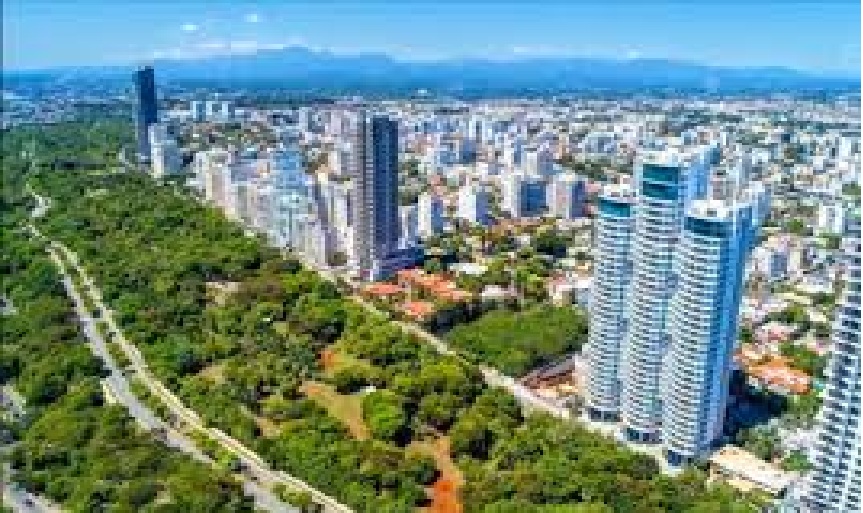
The architectural landscape of the Dominican Republic, especially in Santo Domingo, demonstrates significant economic and urban progress. The construction of increasingly taller and more complex buildings—from residential and commercial towers to mixed-use projects with international hotels—reflects an era of modernization and ambition. These skyscrapers not only transform the city’s skyline but are also fundamental to the country’s socioeconomic development, generating employment, attracting investment and tourism, and improving urban infrastructure.
Iconic projects like the Torre Caney (153 m) and Torre Anacaona 27 (171 m) not only rank among the tallest in the Caribbean but also symbolize the growing confidence in the local real estate market and the Dominican Republic’s potential as a hub for innovation and growth in the region. This construction momentum, if guided by sustainable planning and future vision, will not only elevate its skies but also the quality of life and prosperity of its people.
Acerca del autor